

Is the woven bag cutting, sewing, printing, and receiving integrated machine widely applicable?
Many packaging processing factories hesitate before purchasing equipment: the integrated cutting, sealing, printing, and receiving machine seems highly integrated in function, but how wide is its actual coverage in terms of order types, materials, and industries? Is it only suitable for making single-category bags, requiring frequent equipment adjustments when orders change, leading to low utilization rates?
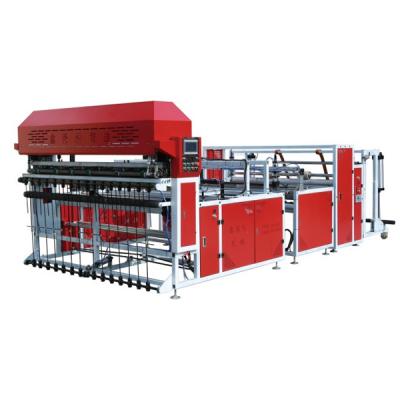
Objectively speaking, this all-in-one machine is a highly versatile main model for the post-processing of woven bags. It integrates five processes—printing, fixed-length cutting, edge folding and bottom sewing, automatic counting, and bag stacking and collection—into a single production line, eliminating the need for multiple separate machines for segmented processing. Whether in terms of raw material adaptability, finished bag types, downstream industry demands, or the production modes of factories of different scales, its compatibility is extremely broad, and its applicability far exceeds that of traditional single cutting machines, bottom sewing machines, and independent printing machines.
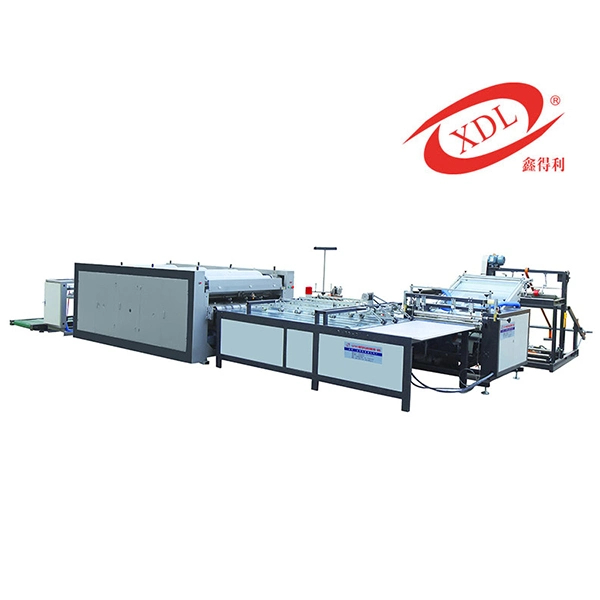
1. Strong raw material compatibility, basically compatible with mainstream woven fabrics.
Starting from the processing base material, it is not limited to ordinary polypropylene tubular fabric; most common woven fabrics on the market can be produced stably:
Conventional PP and PE round woven fabric are the basic compatible materials. Common 60–120 gram bag materials are easy to set up on the machine, with smooth cutting, sewing, and printing synchronization; laminated or coated waterproof woven fabric can also be processed. The equipment supports a cold cutting mode to avoid high-temperature heat cutting damaging the coating layer, preventing wrinkling or delamination issues; for thick industrial heavy-duty woven fabric, after replacing the carbide blade and fine-tuning the sewing tension, stable cutting and sewing can be achieved for high-gram-weight load-bearing bag production.
The only limitation is minimal; ultra-thin non-woven fabrics and rigid plastic films are not within its processing scope. The equipment itself is positioned as a dedicated woven bag making machine, which is not a design shortcoming.
Second, it covers a full range of bag types, capable of producing most conventional commercial woven bags.
Thanks to the PLC touch screen parameter-adjustable design, bag length, bag width, edge folding method, and cutting mode can be changed at any time without replacing rollers or molds, making it easy to switch between multiple bag types for production. This is also the core reason for its strong versatility.
Grain and oil packaging bags
Rice bags, wheat bags, corn storage bags, flour bags, and coarse grain packaging bags are widely circulated in the market. Open-mouth woven bags can be produced in batches. Blank bags can be directly cut and sewn for collection, or brand names and specification text can be printed in one go before forming. The finished bags have tight stitches, making them resistant to bursting when stacked with grain.
Agricultural fertilizer, feed, and livestock packaging bags
Urea bags, compound fertilizer bags, organic fertilizer bags, and various livestock and poultry feed bags are common order categories for this equipment. It can produce both ordinary flat bags and customized seven-mouth valve bags with corresponding machine models. Waste packaging bags from farms and silage outer packaging bags have significant advantages in large-scale contract manufacturing.
Building materials and powder chemical packaging bags
Putty powder bags, cement bags, sand and gravel aggregate packaging bags, and industrial powder raw material bags are in high demand. These bags require high firmness of the sewn bottom and dimensional uniformity. Integrated production can avoid issues of uneven thickness and length deviation caused by manual sewing; woven bags for ordinary chemical raw materials and granular raw materials are also suitable.
Logistics packaging, general turnover packaging bags
Large express packaging bags, second-hand material packaging bags, construction waste storage bags, hardware accessory turnover bags—both small batch miscellaneous orders and large batch unified orders can be flexibly undertaken. Many packaging material processing plants use this single machine to handle various scattered bag-making orders in the surrounding area.
Customized OEM bags
Many packaging factories take on outsourced OEM orders, where customers require logos, factory addresses, and product descriptions printed on the bags. The traditional process involves outsourcing printing, then cutting, then sewing the bottom, which is cumbersome and results in high material loss. The integrated cutting-sewing-printing machine produces finished products directly from a roll of material, with simultaneous front and back printing and precise alignment, making it suitable for small to medium batch custom orders.
Third, it is adaptable to downstream industries across the board, covering almost all application scenarios for woven bags.
As long as an industry requires woven bag packaging, this equipment can basically meet production needs. The downstream layout is highly diversified and stable:
Grain and oil processing enterprises, agricultural material and fertilizer manufacturers, and feed processing plants mostly have their own bag-making production lines to produce outer packaging bags independently, reducing outsourcing procurement costs; building material powder plants, new material chemical plants, and mineral particle processing plants set up small-scale bag-making workshops to produce packaging bags on demand, minimizing inventory backlog; logistics packaging stations and waste recycling industrial zones purchase equipment to produce their own packaging bags to meet daily packaging needs; professional packaging product processing factories are the main users, undertaking various woven bag processing orders based on supplied materials or custom designs, leveraging the equipment's versatility to accept more types of orders; even agricultural and sideline product processing plants and local specialty processing factories can use this equipment to produce customized woven bags for local specialty packaging.
4. Adaptable to factories of different sizes, suitable for both large and small plants, with low site requirements
Many people mistakenly believe that integrated equipment is bulky and only suitable for large factories, but in fact, it adapts to production entities of different scales, further expanding its applicable scenarios:
Small family workshops and micro-processing plants: a single machine can be operated by one person, placed on ordinary leveled factory floors without special infrastructure modifications, handling thousands of small orders daily with ease and low initial investment thresholds. Small to medium-sized packaging processing plants: can use a single machine as the main production line or arrange multiple machines side by side to form an assembly line, handling both scattered small orders and large batch orders of tens of thousands, with changeovers completed within half an hour. Large-scale woven plastic industrial park factories: this equipment serves as a flexible supplementary line for urgent and custom orders, complementing high-speed dedicated bag-making main lines to enhance overall order capacity.
5. Small-scale limitations: only by recognizing the boundaries can one avoid blind purchasing.
Although it has a wide overall applicability, it is not a universal device and has clear application boundaries:
First, extremely narrow, extra-wide, or extra-long special-shaped woven bags require customized wider and longer models, as standard general-purpose models have processing limitations. Second, corrosion-resistant special woven bags, geotextiles, and waterproof tarpaulins fall outside the scope of conventional processing. Third, high-end multi-color fine printing is limited by the number of printing stations on the machine, making complex full-color printing less effective than professional gravure printing machines; simple text and single-color logos are more suitable scenarios.
Overall, the woven bag cutting, sewing, printing, and receiving integrated machine has a very wide range of applications. It has strong adaptability in terms of raw materials, bag types, downstream industries, and production scales ranging from small to large. One machine can replace four to five workers and three to four separate single-machine processes, offering high order flexibility and low idle rate.
As long as the main business involves conventional civil and industrial woven bag production—whether for self-use or outsourced order processing—this machine is highly suitable. Only manufacturers that have long specialized in special fabrics or high-end complex color-printed irregular-shaped bags need to carefully match the machine model. Apart from that, the vast majority of plastic weaving practitioners will find it a good fit.




 鲁公网安备 37162202000141号