

Comparison between semi-automatic and fully automatic cutting and sewing integrated machines
In fields such as woven bag packaging, road infrastructure, and flexible fabric processing, the cutting and sewing integrated machine has long replaced decentralized cutting and sewing processes, becoming the core carrier of process integration. The semi-automatic and fully automatic models are not merely additions or reductions in configuration, but represent a generational divergence in production logic, precision systems, cost models, and applicable scenarios. There is no absolute superiority between the two; only by matching the enterprise's production scale, order structure, and long-term operational planning can a better balance between equipment investment and output value be achieved. This article breaks down the essential differences between the two types of equipment from six dimensions: operational logic, precision and quality, labor efficiency, investment cost, maintenance adaptability, and application scenarios, providing practical references for selection decisions.
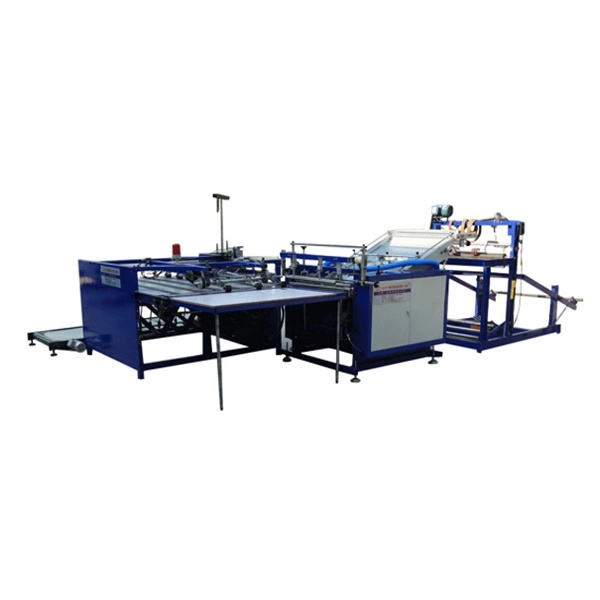
1. Operation Logic: Manual Assisted Transition vs. Full-Process Closed-Loop Automatic Control
Semi-Automatic Slitting and Seaming Integrated Machine
Essentially a semi-integrated auxiliary processing unit, where the cutting and sewing main actions are completed by the equipment, but material transfer, alignment calibration, start-stop control, and finished product collection heavily rely on manual intervention. Operators need to load materials roll by roll, manually align edges, make real-time fine adjustments to positioning, and manually unload and stack finished products after each single process; when changing product specifications, all parameters and limit structures must be manually adjusted and reset one by one. The entire machine only combines the 'cutting + sewing' actions, without forming a complete production line from loading → positioning → processing → collection. There are manual pauses and breaks between processes, and the production pace is directly determined by the operator's skill level.
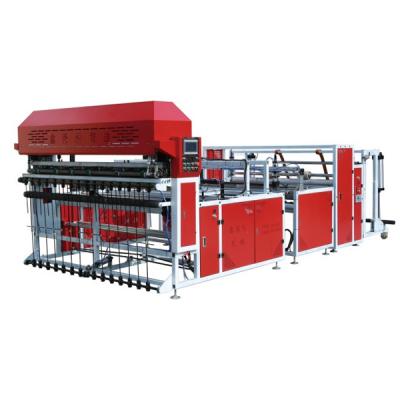
Fully automatic cutting and sewing integrated machine
Relying on PLC programmable controllers, servo drive systems, photoelectric color mark correction, and length sensing modules, a fully closed-loop autonomous operation system is established. The entire process—from material feeding, correction and fixed-length positioning, precise cutting, synchronous sewing, thread trimming, counting, to finished product stacking and collection—operates autonomously. Operators only need to input process parameters such as dimensions, stitch length, and speed in advance. Once started, the equipment autonomously completes continuous cyclic production. In the event of material deviation, material shortage, or blockage, sensors immediately trigger a shutdown alarm, eliminating the need for real-time manual monitoring and intervention. From raw material rolls to finished product output, an uninterrupted production line is formed, completely eliminating inter-process waste. It serves as an intelligent carrier for standardized mass production.
2. Processing Accuracy and Finished Product Stability: Human-Induced Floating Errors vs. CNC Constant Tolerances
Consistency of finished products is a core indicator for mass production. The accuracy gap between the two types of machines stems from different sources of error.
In semi-automatic models, positioning and material feeding are entirely influenced by manual operation. Prolonged work leads to operator fatigue, gesture deviations, and material placement misalignment, easily resulting in uneven cutting lengths, skewed stitching, and inconsistent edge banding tightness. The defect rate in batch production is relatively high, and the tolerance fluctuation range is larger. For color-printed packaging bags requiring alignment processing, manual registration struggles to ensure precise matching between patterns and cuts, leading to high rework rates for corners and edges, meeting only basic processing requirements for ordinary low-end goods.
The fully automatic model achieves millimeter-level precision control through servo fixed-length and photoelectric tracking. The feeding speed, cutting depth, and sewing tension are consistently output by the program, eliminating human interference throughout the process. The finished products in the entire batch exhibit highly uniform dimensions, seam types, and cut edge flatness, with controllable tolerances remaining stable. For high-demand processes such as color printing alignment, hem sealing, and multi-layer composite thick materials, the automatic correction system adjusts material deviation in real time, significantly reducing waste and scrap. It meets the strict quality inspection standards of high-end orders and export goods, ensuring minimal quality fluctuation during long-term mass production.
III. Human Resource Allocation and Operational Efficiency: Single Operator per Machine vs. One Operator Managing Multiple Machines
Human Resource Input
In semi-automatic mode, rigid one-person-one-machine configuration requires operators to remain at their stations throughout the entire process, continuously moving back and forth for loading and unloading, resulting in high labor intensity and persistently high fixed labor costs for enterprises. When multiple small and medium-sized production lines operate in parallel, an equal number of operators must be assigned, creating significant pressure on workforce size.
The fully automatic mode offers outstanding labor intensification advantages. One skilled maintenance worker can simultaneously oversee 2–3 machines, handling only coil material replenishment, finished product transfer, and regular inspection and maintenance on a daily basis, without the need for real-time operational intervention. A single production line can reduce labor demand by over 60%, and as the production cycle extends, the cost-saving effect on labor will continue to amplify.
Production capacity performance
Semi-automatic is limited by manual rhythm, with frequent starts and stops, intermittent processes, and a clear upper limit on hourly output, making it suitable for intermittent, small-batch, discontinuous production scheduling; fully automatic operates continuously without interruption, increasing unit-time output by 30%–60%. When facing large-volume rush orders and uninterrupted two-shift production, the capacity advantage is further amplified, effectively shortening order delivery cycles.
IV. Investment and Lifecycle Cost: Low Initial Threshold vs. Long-Term Amortized Total Cost
Initial Purchase Cost
The semi-automatic integrated cutting and sewing machine has a simple structure and basic electrical control configuration, resulting in a lower overall machine price and a smaller capital investment threshold, making it suitable for small and micro enterprises with limited budgets in the startup phase, easing early-stage capital turnover pressure.
Fully integrated servo motors, multiple sensor modules, intelligent control systems, and closed-loop transmission structures result in higher hardware configuration complexity, higher total equipment procurement costs, greater one-time fixed asset investment, and certain requirements for the company's initial capital reserves.
Total long-term operational cost
In the short term, semi-automatic machine purchases are more cost-effective, but when factoring in labor wages, scrap losses, rework and repair costs, and defective product discount losses, the comprehensive operational cost over three to five years increases year by year. Although fully automatic machines have higher initial purchase costs, they offer advantages such as labor savings, lower waste, and reduced rework, reducing material loss rates from 5% to below 1%. Over the long term, overall production costs are more favorable, and the return on investment cycle is clear and controllable.
Energy consumption and maintenance costs
The semi-automatic transmission structure is simple, requiring only regular replacement of blades, sewing needles, and lubrication maintenance. Repair parts are inexpensive, and the maintenance threshold is low, allowing ordinary operators to handle basic faults. Fully automatic electrical and sensor components are highly precise, requiring regular calibration of sensors and servo systems. Maintenance requires greater expertise, and parts are more expensive, but the equipment structure is more rigid, resulting in lower failure rates during prolonged continuous operation and less frequent major overhauls.
V. Flexible Adaptability: Small batch quick changes vs. Large-scale standardized deep cultivation
Semi-automatic model changeover and debugging threshold is low; when changing product width, length, or process style, simple manual adjustments to limits and wiring allow for quick production, with short changeover time, making it highly suitable for business models involving multiple specifications, small batches, scattered orders, and frequent order changes, such as small processing plants handling scattered foreign trade leftovers, customized niche packaging, and sporadic road repair and cutting projects.
The fully automatic machine model logic is biased towards single-specification mass production. The first mold change requires resetting the program, calibrating the photoelectric sensor, and debugging servo parameters, resulting in a longer changeover preparation cycle. However, once the new model is finalized, its stability during long-term large-scale production is irreplaceable, making it suitable for fixed categories, long-term large orders, standardized assembly line factories, as well as continuous cutting and jointing scenarios on high-speed roads, airport runways, and large municipal infrastructure projects.
VI. Scenario Selection Summary: Matching According to Needs is the Optimal Solution
Prioritize semi-automatic joint cutting all-in-one machines
Start-up small workshops and small-scale processing plants with low daily capacity demand, limited budget, and need to control initial equipment investment;
Orders are scattered and varied, with frequent changes in specifications and models, mostly small-batch custom orders, requiring high flexibility in mold changes;
Intermittent minor repair works and short-distance scattered road joint cutting operations, with sporadic starts and stops and short continuous operation durations;
The product quality requirements are average, with no strict acceptance standards for dimensional consistency or appearance regularity.
Prioritize the deployment of fully automatic joint cutting integrated machines.
Medium to large-scale production enterprises with massive daily production capacity, undertaking large-volume fixed orders year-round;
Products positioned in the mid-to-high-end market and export orders, with strict customer requirements for dimensional tolerances, appearance quality, and batch consistency;
Plan to streamline labor and promote intelligent production line transformation, improving overall profit margins by reducing labor and minimizing waste;
Large-scale infrastructure joint cutting operations on highways, major municipal roads, and airport terminals, requiring straight cutting lines and uniform depth to meet standardized engineering acceptance criteria;
Long-term two-shift or three-shift continuous production aims to achieve better overall long-term production costs.
The choice between semi-automatic and fully automatic integrated cutting and sewing machines is never a one-way comparison of 'the higher the end, the better,' but rather a two-way alignment between the pace of business operations and the level of automation. Semi-automatic machines, with their flexibility and low cost, serve the small and micro market and are a practical and stable configuration for the startup phase; fully automatic machines, with intelligent and stable production, empower large-scale upgrades and are the core lever for long-term cost reduction, efficiency improvement, and building quality competitiveness. Only by understanding the fundamental differences in their underlying performance, anchoring one's own order structure, production capacity planning, and profit model, can one make equipment investment decisions that balance current cash flow security with long-term development potential.




 鲁公网安备 37162202000141号