

How to choose a high-quality woven bag cutting, sewing, printing, and receiving integrated machine manufacturer?
On the production lines of feed, fertilizer, grain, and chemical packaging processing plants, the integrated cutting, sewing, printing, and bagging machine is a core automated device. A single machine integrates multiple processes such as feeding, correction, printing, cutting, bottom sewing, and counting bag collection, directly determining workshop labor costs, finished product defect rates, and long-term production stability. Currently, the market is flooded with equipment manufacturers of varying quality. Many small workshops capture market share with low prices but significantly cut corners on materials, electronic controls, and after-sales service. After commissioning, frequent shutdowns for repairs lead to even greater losses. To select a high-quality manufacturer that matches your own production capacity needs, you should not only look at the quoted price but also comprehensively evaluate five key dimensions: your own requirements, the factory's actual strength, core equipment configuration, on-site testing, and full-cycle after-sales service.
First, clarify your own production needs, then match with the corresponding manufacturer's models
A common mistake many buyers make: comparing prices first, then considering the production scenario, and finally ending up with equipment that has excessive features or insufficient configuration. The first step in selecting a manufacturer is to sort out the actual production conditions of the workshop, and then screen manufacturers with suitable product lines accordingly.
Clarify bag type, material, and printing requirements
The width and length range of woven bags produced daily, as well as whether laminated bags, color-printed bags, or inner film composite bags are needed, directly determine the machine cutting structure and printing module configuration. Producing ordinary white bags only requires simple single-color printing; long-term production of color-printed packaging bags requires the manufacturer to be equipped with a high-precision color mark tracking servo system and a hot and cold dual-cutting blade structure, accommodating both cold cutting for laminated bags and hot cutting for ordinary woven bags. If the manufacturer only produces basic single-model machines and cannot customize additional modules such as printing stations, handle punches, or vent holes, even a low price is not suitable for long-term cooperation.
Determine the equipment speed level based on daily production capacity.
Small workshops produce several thousand woven bags per day, suitable for basic machines with a speed of 30-40 bags per minute; medium-sized processing plants have a daily output of 10,000 to 20,000 bags, preferring high-speed integrated machines running at 40-60 bags per minute; large-scale packaging plants and major chemical supporting workshops can connect with manufacturers capable of producing fully automatic high-speed models with a speed of over 60 bags per minute, and some large factories can also provide multi-unit integrated line solutions. By informing the manufacturer of the daily output and single-shift or two-shift work system in advance, professional manufacturers will offer targeted machine solutions rather than uniformly promoting more expensive equipment.
Check the workshop space and power supply conditions.
The overall length of the integrated machine is relatively long, so it is necessary to confirm the factory floor space and three-phase power load; some older workshops have large voltage fluctuations, so it is necessary to ask the manufacturer whether the electronic control system supports wide voltage adaptation. Regular manufacturers will send technical personnel to conduct on-site surveys and adjust the equipment layout plan, while small workshops mostly only provide parameters online and do not offer on-site survey services.
2. Check the comprehensive strength of the manufacturer and eliminate equipment suppliers from small workshops without proper qualifications
The integrated cutting, sewing, and printing machine is a heavy-duty electromechanical device. Its R&D, sheet metal processing, assembly, and quality control all require a complete production line. Intermediaries or small processing points that only assemble and resell can hardly ensure the long-term stability of the equipment. When evaluating the strength, focus on four key points.
1. Factory scale and independent processing capabilities
High-quality original manufacturer has its own standardized production workshop, equipped with steel plate bending, CNC lathes, and welding processing equipment, and independently processes core components such as frames and transmission supports; while OEM merchants and small workshops lack processing capabilities, relying entirely on purchased parts for assembly, resulting in thin frame steel plates and rough welds, prone to vibration and deformation during high-speed operation. During on-site visits, observe whether the workshop has a batch assembly line for complete machines and whether there are workstations for independent processing of semi-finished frames, tool holders, and printing rollers.
2. R&D and Patent Technology Reserves
Manufacturers with independent R&D capabilities will establish dedicated mechanical and electrical control R&D teams, hold utility model and invention patents related to cutting and correction, integrated printing, and automatic bag collection, and can continuously iterate and optimize machine models to adapt to new bag-making processes on the market. It is advisable to request the manufacturer to present patent certificates and product iteration records; pure assembly manufacturers have no R&D investment, their equipment structures remain unchanged for years, and basic issues such as inaccurate correction, printing ghosting, and large bag length errors are difficult to resolve. At the same time, priority should be given to manufacturers that have passed ISO9001 quality management system and CE safety certification, as their quality control processes are more standardized.
3. Real customer implementation cases and industry reputation
Peer reputation is a more intuitive reference. You can ask the manufacturer for customer addresses of packaging factories in the same region and product category, and visit the site yourself to see the actual operating status of the equipment. Reliable manufacturers will not avoid customer inspections and can showcase long-term cooperation cases such as feed mills, fertilizer plants, and flour processing plants. If the manufacturer only provides blurry images and refuses on-site machine inspections, the equipment likely has a high failure rate. You can also consult local professionals in the woven plastic industry to avoid merchants who shirk after-sales responsibilities and overcharge for spare parts.
4. Distinguish between original factories and intermediaries
Intermediaries do not have production workshops; they source equipment from multiple small factories, making it impossible to control assembly quality. If subsequent failures occur, they cannot connect with the original manufacturer's technical staff. In contrast, original manufacturers integrate production and sales, managing the entire process from sheet metal and electrical assembly to delivery independently. They can customize hem width, sewing stations, and bag stacking structures according to customer needs, offering greater flexibility in solutions.
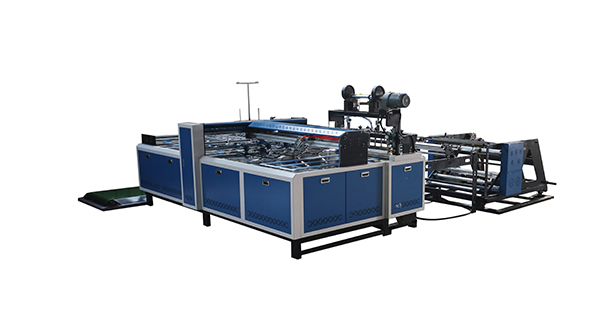
3. Disassemble the core configuration of the equipment to determine whether the manufacturer has cut corners on materials
For integrated machines with the same appearance, the price difference can reach tens of thousands. The core differences lie in four major components: the frame, transmission, electrical control, and cutting and sewing. When sourcing and negotiating, each item in the configuration list must be checked one by one to prevent manufacturers from passing off inferior products as high-quality ones.
Machine body frame and transmission structure
The entire machine frame must be made of thickened solid steel plates welded as one piece, subjected to aging treatment to prevent deformation under long-term full-load operation; low-cost equipment often uses thin iron sheets spliced together, causing severe shaking of the machine body at high speeds, leading to skewed stitching and misaligned printing. The transmission system should preferably use a full set of servo motors to drive the feeding, cutting, and printing stations. Compared to ordinary variable-frequency motors, servo motors offer higher positioning accuracy, with bag length errors controlled within ±0.3mm, lower noise, and fewer failures. For wear parts such as guide rails, bearings, and feed dogs, reputable manufacturers use first-tier domestic brand components, while low-end equipment uses cheap parts to cut costs, resulting in jamming and wear within 3-6 months.
Electrical control and intelligent control system
The whole machine adopts a well-known brand PLC paired with a color touch screen. Multiple bag-type process parameters can be stored and switched with one key. It is easy to operate, and ordinary workers can master it within half a day. The system comes with automatic deviation correction, thread break alarm, material shortage shutdown, overload protection, and fault code self-diagnosis functions. Once the fabric roll shifts or sewing thread breaks, the machine automatically stops and alarms, greatly reducing waste losses. Inferior equipment uses cheap and simple controllers without automatic deviation correction, requiring frequent manual adjustments, resulting in high waste rates.
Printing, cutting, and sewing core modules
In the printing unit, the material of the printing roller and the color mark tracking sensor are inspected. For making color bags, high-precision photoelectric tracking must be equipped to ensure pattern cutting and alignment without deviation. The cutting structure is divided into three types: cold cutting, hot cutting, and combined cold-hot cutting. High-quality models use alloy material for the cutter head, resulting in smooth cuts without sticking, and a very low probability of bag jamming. For the sewing head, an industrial-grade high-speed sewing machine is preferred, supporting switching between single-fold and double-fold edges, with adjustable stitch length, ensuring firm stitching and low thread breakage. Low-cost equipment has a roughly made sewing head, leading to frequent skipped stitches during high-speed sewing.
Automated auxiliary configuration
Pneumatic automatic loading rack, automatic bag stacking and collecting, counting and stacking, pneumatic punching, handle punching mold and other optional functions; regular manufacturers support on-demand installation without replacing the entire machine. Small workshop models have fixed structures, making later modification and installation extremely costly or even impossible.
4. On-site machine testing and actual measurement to visually verify the real performance of the equipment.
Simply looking at parameters and pictures can be misleading. After confirming the target manufacturer, be sure to go to the factory for trial production. Use your own commonly used woven fabric rolls for testing, and focus on observing the following indicators:
Run at full load for half an hour continuously, observe the machine's vibration amplitude, noise level, whether the bag length varies, and whether the printed patterns have ghosting or misalignment.
Continuously cut hundreds of bags, check the flatness of cuts and uniformity of stitching, and count the number of defective items;
Simulate fabric breakage and misalignment conditions to test the sensitivity of automatic correction and fault alarm functions;
Quickly switch between two different bag lengths, check the convenience of parameter adjustment, and measure the time required for changeover.
If frequent misalignment, skipped stitches, or blurred printing occurs during the trial run, it indicates that the manufacturer's mechanical structure or electronic control adjustment process is immature; even if the quoted price is low, it is not advisable to choose.
5. Finalize comprehensive after-sales service to avoid maintenance issues after production launch.
Woven bag equipment is a heavy-duty machine that can operate continuously for 24 hours. If after-sales service is inadequate, a single breakdown can delay the delivery of an entire vehicle order. Before signing the contract, all after-sales details must be fully documented in writing; verbal promises are not valid.
Warranty period and coverage scope
Reputable manufacturers offer a 1-2 year full machine warranty, with extended warranties for core components such as servo motors, PLCs, sewing heads, and main motors. The scope of the full machine warranty and the warranty for consumable parts should be clearly distinguished (blades, oil seals, sensors, and other consumables are not covered under long-term warranty and must be listed in advance). Some high-quality manufacturers provide a three-year full machine warranty. Be cautious of sellers who advertise a 'lifetime warranty' but do not specify the supply cycle of spare parts, as they often sell spare parts at high prices later.
After-sales response and on-site timeliness
Prioritize local or nearby manufacturers, agreeing that technical staff will respond online within 24 hours of a fault report and conduct on-site repairs within 48 hours; for long-distance manufacturers, confirm regional service points to avoid waiting over a week for repairs after equipment failure. Also, ensure that upon equipment delivery, the manufacturer provides free on-site installation and commissioning, and arranges for technical staff to stay at the factory to train operators on daily maintenance and simple fault troubleshooting.
Parts supply and maintenance support
Inquire about the regular inventory and delivery cycle of wear parts. High-quality manufacturers often stock a full set of replacement parts, enabling fast online shipping. Also, request a complete equipment maintenance manual and arrange regular online technical follow-ups to monitor equipment operation status. Many low-cost manufacturers have insufficient parts inventory, requiring temporary processing of damaged components, which significantly extends downtime.
Value-added supporting services
Stronger manufacturers provide supporting services such as workshop production line planning, old equipment upgrades, and complete machine relocation and commissioning. When expanding production capacity and adding units later, seamless integration with the original technical team is possible, ensuring better compatibility.
VI. Procurement pitfalls to avoid: Don't make decisions based solely on low prices.
When many processing plants purchase equipment, they blindly aim to lower budgets and choose cheaper equipment from smaller factories. While this may seem to save tens of thousands in procurement costs upfront, after production begins, additional expenses arise each month due to defective products, downtime, and frequent part replacements. Over the course of a year, the total losses far exceed the initial price difference. When selecting a manufacturer for integrated cutting, sewing, printing, and receiving machines, the core logic is to 'prioritize matching your own production capacity needs, followed by equipment configuration, and finally after-sales support as a safety net.'
The screening process can be simplified as: sort out workshop production needs → screen 3-5 source factories → conduct on-site inspections of factories and customer cases → test machine performance on-site → check configuration lists item by item → confirm written after-sales warranty terms, compare multiple options, and choose the best partner based on overall cost-effectiveness. Only automation equipment that operates stably over the long term can truly reduce labor and losses, continuously generating profits for woven bag processing plants.




 鲁公网安备 37162202000141号