

Woven Bag Cutting, Sewing, Printing, and Receiving Integrated Machine: The Core of Efficient Upgrades in the Packaging Industry
In the fields of agricultural materials, chemicals, and building materials, woven bags serve as the core packaging carrier for products, and their production efficiency and quality directly affect the operational costs of downstream enterprises. Traditional woven bag production relies on a series of separate machines such as cutting machines, bottom sewing machines, printing machines, and material collecting machines, which suffer from issues like large floor space, high labor requirements, and significant errors in process衔接. The widespread adoption of integrated woven bag cutting, sewing, printing, and collecting machines is fundamentally transforming this industry landscape, making them the core equipment for small and medium-sized packaging enterprises to upgrade their production capacity.
From the core structure perspective, the integrated cutting, sewing, and printing machine deeply integrates key processes in woven bag production: the front-end fixed-length cutting device uses photoelectric positioning to precisely control bag length, ensuring smooth and burr-free cuts; the mid-section double-thread overlock system employs chain stitching, with a sewing strength more than twice that of single-thread stitching, capable of bearing loads exceeding 50 kg; the middle printing unit typically uses gravure or flexographic printing, with registration accuracy controlled within ±0.1 mm, clearly reproducing brand logos, product parameters, and execution standards; the rear-end automatic collecting device neatly stacks the finished bags, reducing the cost of subsequent manual sorting. Compared with separate equipment, the integrated machine significantly improves process synchronization, avoiding errors caused by manual transfer and mold changes, reducing the defect rate from the traditional 3%-5% to below 1%, and greatly enhancing product consistency.
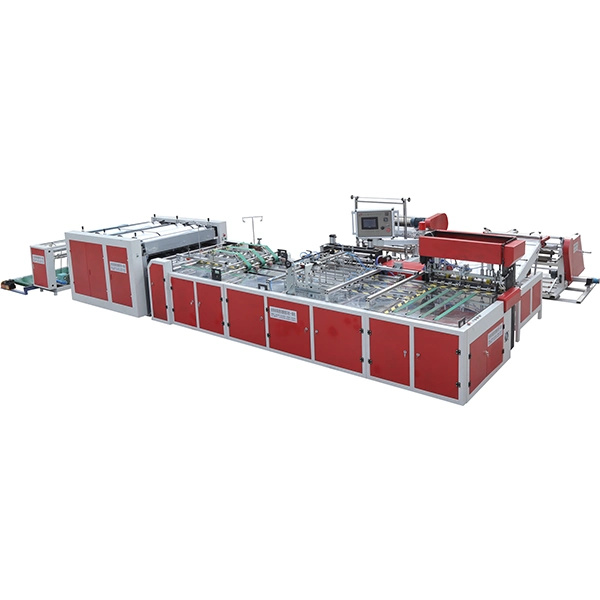
In practical applications, the core advantage of an integrated machine lies in the dual optimization of efficiency and cost. The production speed of a mid-to-high-end integrated machine can reach 80-120 units per minute, equivalent to the total output of 3-4 separate units; its energy consumption is only 65% of the total of multiple separate devices, further reducing production costs. At the same time, the flexibility of the integrated machine also meets the current market's demand for multiple varieties: by adjusting parameters, it can quickly switch between different specifications of fertilizer bags, feed bags, and cement bags, with printing roller replacement taking only 30 minutes, solving the pain point of traditional integrated machines being limited to producing a single specification.
From the perspective of application scenarios, the integrated cutting, printing, and sealing machine widely serves the core downstream of woven bags: in the agricultural materials industry, packaging for fertilizers and pesticides requires clear product identification and high-strength stitching, and the machine's printing precision and seam quality fully meet these requirements; in the chemical industry, packaging for plastic pellets and pigments demands high sealing performance, and the machine's cutting accuracy and automatic material collection efficiency effectively improve packaging pass rates; additionally, in scenarios such as cement bags for construction materials and grain logistics bags for agricultural products, the integrated machine enables standardized and efficient production.
With the advancement of intelligent manufacturing, the integrated cutting, sewing, and printing machine is upgrading towards intelligence and environmental protection: some models have incorporated AI visual inspection systems that can identify printing defects, weak seams, and other issues online and automatically remove defective products; remote monitoring functions enable real-time collection of equipment operation data, supporting predictive maintenance; the printing process uses environmentally friendly soybean oil-based ink that meets food contact standards, catering to the packaging safety requirements of e-commerce, fresh food, and other sectors. It can be said that the integrated cutting, sewing, and printing machine is not only a hardware upgrade for woven bag production but also a key driver for transforming the packaging industry towards efficiency, intelligence, and sustainability, providing solid packaging support for the development of downstream industries.




 鲁公网安备 37162202000141号