

What parameters to look for when purchasing a woven bag cutting and sewing integrated machine
The woven bag cutting-sewing integrated machine is the core equipment for batch production of woven bags in industries such as plastic packaging, agricultural supplies, building materials, and logistics. Its performance directly determines production efficiency, finished product quality, and long-term operating costs. When purchasing, if one is guided only by price, it is easy to fall into the dilemma of “cheap to buy but expensive to use.” Therefore, it is necessary to focus on the following core parameters to ensure the equipment matches your own production needs.
First, the core production efficiency and precision parameters are the basic indicators for procurement. First, operating speed and production capacity: the continuous operating speed of mainstream models is mostly 80–150 meters per minute, corresponding to a production capacity of 12,000–30,000 units per hour. The choice should match the average daily order volume: for large agricultural material factories with daily orders exceeding 100,000 units, high-speed models are needed to avoid production bottlenecks; small and medium-sized workshops can choose basic models with a speed of 80 meters per minute, balancing efficiency and cost. Second, processing specification adaptability: it is necessary to clarify the width of woven fabric the equipment can handle (generally 25–120 cm) and the weight (50–250 g/m²), and especially to confirm the ease of adjusting for different bag lengths. High-end models can switch specifications in just a few minutes without disassembling parts, significantly reducing downtime during changeovers. Third, processing precision: the stitching error should be controlled within ±0.5 mm, the cutting edge flatness deviation ≤ ±0.3 mm, with no skipped stitches or frayed edges. For high-strength load-bearing bags such as those for fertilizer and cement, insufficient precision can easily lead to material leakage or thread detachment, causing the defect rate to soar by over 15%, directly impacting profits.
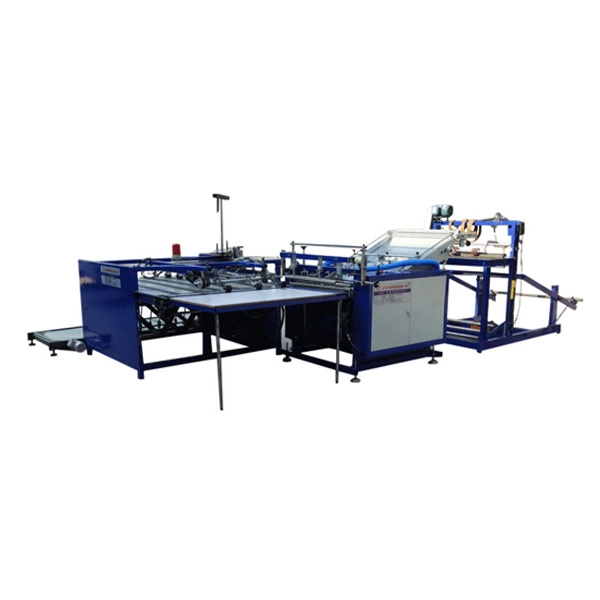
Second are the mechanical structure and stability parameters, which determine the equipment's lifespan and failure rate. For core components, servo motors are preferred for power, offering 30% higher precision and 40% lower failure rate than ordinary asynchronous motors, capable of stable 24-hour continuous operation; for transmission, a synchronous belt + gearbox combination is recommended, which is quieter, has less wear, and extends service life by 2–3 years compared to chain drives. The feeding and correction system is key to avoiding defective products; a fully automatic photoelectric correction mechanism is standard, automatically correcting woven fabric deviation without manual adjustment; the storage rack capacity is recommended to be ≥500 kg to reduce manual material replenishment frequency and suit long-term continuous production. The cutting and sewing components require special attention: the cold cutter hardness should reach HRC58-62, ensuring durability and no chipping, capable of handling high-grammage woven fabrics; the sewing needle must support switching between flat sewing and overlock sewing—industrial heavy-duty bags require overlock sewing, while food bags need flat sewing without skipped stitches, to meet different customer needs.
Finally, intelligent control and hidden cost parameters are the core of long-term operation. The control system should prioritize a PLC + touchscreen combination, capable of storing over 20 sets of production parameters, allowing one-click recall when switching specifications, and featuring fault self-diagnosis and automatic shutdown upon thread breakage to reduce labor costs. Expandability parameters cannot be ignored either—whether reserved interfaces allow for adding a coding machine, valve mouth assembly device, or direct connection to a circular loom, so future capacity expansion does not require replacing the entire machine, reducing sunk costs. Hidden parameters such as energy consumption: servo-driven models save 15–25 kWh per hour compared to standard models, and based on 300 days of operation per year, can save 30,000–60,000 yuan in electricity costs—a significant cost advantage for small and medium-sized manufacturers.
When purchasing, it is necessary to combine your own positioning, verify the authenticity of parameters through on-site machine testing, rather than just listening to the manufacturer's verbal promises, to ensure that the purchased equipment is easy to use, sufficient, and durable, thereby reducing costs and increasing efficiency for enterprise production.




 鲁公网安备 37162202000141号