

How to choose an all-in-one woven bag cutting and sewing machine? Pay attention to these points
The woven bag cutting and sewing machine is the core equipment of plastic woven production, which directly determines the production capacity, finished product quality and long-term cost. Many manufacturers only look at the price when purchasing a machine and ignore key issues such as adaptability and stability. As a result, frequent failures and high defective rates delay production. Based on practical experience in the industry, let’s talk about how to choose a reliable all-in-one cutting and sewing machine from aspects such as core requirements, performance configuration, detailed design, and after-sales guarantee.
1. First clarify the production needs and lock in the basic model
The first step in selecting equipment is not to compare parameters, but to clarify your own production scenarios to avoid excessive functions or insufficient configuration.
Look at bag specifications and materials
First determine the width, length, weight of the commonly used woven bags, and whether they are color printed. Conventional bags are mostly 350-750mm wide, 400-1200mm long, and 60-120g in weight, which can be adapted to ordinary models. If it is an extra-wide or extra-long bag, or a thick material or film-coated bag, you should choose a model with a reinforced frame and a high-power motor; the color-printed bag must have a color mark tracking function to avoid pattern misalignment.
Calculate capacity requirements
For small workshops with a daily output of several thousand pieces, choose the basic model with a daily output of 30-40 pieces per minute; for medium-sized factories with a daily output of 10,000-20,000 pieces, choose the high-speed model with 40-60 pieces/minute; for large-scale production, consider a fully automatic model with more than 60 pieces/minute, and some high-end models can reach 80 pieces/minute. Note: The higher the production capacity, the better. It must match the rhythm of subsequent processes and avoid stacking materials.
Determined cutting method: cold cut or hot cut
Hot cutting: the incision is flat, non-adhesive, and the bag mouth is easy to open. It is suitable for ordinary blank bags and color printed bags. Most of the mainstream models are hot cutting.
Cold cutting: blade cutting without heat deformation, suitable for thick materials, film-coated bags or special materials. Some models support one-click switching between cold and hot cutting.
For small batch and multi-specification orders, priority is given to models with switchable hot and cold temperatures for greater flexibility.
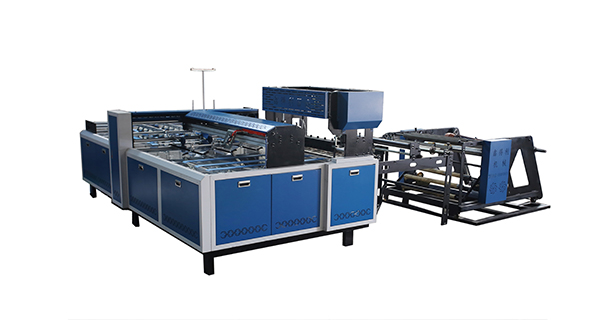
2. Core performance: accuracy, speed and stability are the key
Performance directly affects the finished product qualification rate and production continuity, so focus on these three points.
Cutting and sewing precision
Poor accuracy will lead to bags of varying lengths, skewed seams, and a spike in defective products. The high-quality equipment adopts PLC + touch screen control and servo motor drive. The cutting accuracy can reach ±0.3mm, the stitch length is adjustable from 5-14mm, and the stitches are even and firm. Color printing bags need to test the color mark tracking sensitivity to ensure that each cutting is aligned with the pattern without deviation.
Body and transmission stability
Whether the machine shakes or shakes during operation depends on the frame and transmission components. The frame must be welded with thickened steel plates, with a stable structure and no deformation during long-term high-speed operation. The servo drive is preferred for the transmission part, which is more accurate in positioning, less noisy and has a lower failure rate than ordinary variable frequency motors. At the same time, the guide rails, bearings and other wearing parts are checked, and famous brand accessories are given priority.
Continuous operation capability
Production is afraid of frequent shutdowns. Choose a model with automatic correction, disconnection alarm, material shortage shutdown, and overload protection. It will automatically alarm and shut down when abnormal, reducing waste and equipment damage. You can consult the manufacturer: the downtime rate and mean time between failures (MTBF) of 8 hours of operation at full load. The MTBF of high-quality domestic machines can reach more than 4,500 hours, and the imported machines are even higher.
3. Detailed configuration: practical functions save labor and improve efficiency
Good equipment not only has strong core performance, but also has more worry-free detailed design. Don’t ignore these configurations.
degree of automation
Basic model: manual feeding, manual bag folding, suitable for small batches.
Upgraded model: pneumatic/electric winding, automatic feeding, hemming, bottom sewing, counting, and bag folding. It can be operated by one person, greatly saving labor.
High-end model: with automatic punching, labeling, and packaging linkage functions, suitable for full assembly line production.
Suitable for sewing and hemming
It is confirmed that it supports single/double hems, flat seams/overlock seams, and the hem width is adjustable from 20-30mm to meet different order requirements. The suture head must be firm and not easy to come off, especially for load-bearing bags such as cement bags and fertilizer bags. The quality of the suture directly affects the safety of use.
Easy maintenance design
Preference is given to models with modular design, as parts are easy to disassemble and assemble, and subsequent maintenance and replacement are convenient. The electrical cabinet must be sealed and dust-proof to prevent dust from entering and causing a short circuit; wearing parts such as blades and needles must be universal to facilitate purchase and replacement.
4. Brand and after-sales: avoid small workshops and ensure long-term production
Equipment is a long-term investment, and brand and after-sales service are more important than temporary low prices.
Choose professional manufacturers and avoid three-no products
Priority is given to professional manufacturers that have been cultivating plastic knitting equipment for many years. They have mature technologies and complete accessories. For example, brands that specialize in seam cutting machines have much better quality and stability than other brands. You can visit the factory on-site to see the production workshop and assembly process, or ask to see customer on-site use cases.
Look at core accessories brands
Electrical components (PLC, servo motors, touch screens) are preferably from well-known brands such as Schneider, Delta, and Mitsubishi, which have strong stability and long life. For key components such as motors, bearings, blades, etc., don’t be greedy for cheap and use other brands. Later, there will be many failures and frequent replacement, which will increase the cost.
After-sales protection must be in place
Confirm that the manufacturer provides free installation and commissioning, technical training, core component warranty, and 24-hour after-sales response. Even better is a local or nearby manufacturer, which can provide quick on-site repairs and avoid long-term production shutdowns after equipment failure. At the same time, ask about the price and delivery cycle of wearing parts to prevent excessive price charges in the future.
The core of choosing an all-in-one woven bag cutting and sewing machine is to match your own production needs, taking into account comprehensive considerations such as specification adaptation, performance accuracy, detailed configuration, brand after-sales, etc., and not blindly follow the trend or be greedy for low prices.
A reliable sewing machine can stably produce good products, have fewer failures, and save labor. It is a cost-effective investment in the long run. Only by doing more comparisons, inspections, and tests before purchasing can you choose the equipment that truly suits you.




 鲁公网安备 37162202000141号