

Analysis of thread breakage problems during the sewing of plastic woven bags
In daily sewing processes, both woven and knitted garment processing equipment inevitably encounter malfunctions such as broken needles, broken threads, skipped stitches, fabric wrinkling, and uneven seams. Among these, thread breakage is particularly frequent and difficult to resolve. Therefore, it is necessary to conduct an analysis and discussion on the issue of thread breakage during sewing within the garment industry.
Having had the privilege of extensive and in-depth experience working with numerous garment manufacturers of different types and sizes, coupled with my years of experience in higher education providing a theoretical foundation, I felt obligated to tackle this research topic and compile my findings into a written document, given the rapid development of the garment industry today.
The problem of broken threads can be summarized into two main parts: how to make a quick and correct judgment based on specific thread breakage phenomena and take corresponding measures, and how to correctly solve the relationship between fabric, needle and thread in sewing operations of different types and scales.
Determine the specific wire breakage phenomenon and take appropriate measures.
Regardless of the type of garment processing machinery, even the commonly used and relatively simple flat sewing machine, there are more than ten thread-passing parts (the many thread-passing parts of the sewing equipment cause the bottom and top threads to change the direction of the thread feed in an orderly manner, and obtain the corresponding friction force with appropriate tension and relaxation when shortening the thread feed distance. This is a necessary condition and key to ensuring the interlacing of the threads). If you blindly start from the beginning without understanding the reasons, it will cause an unnecessary waste of human energy and time.
Simply put, thread breaks during sewing usually occur in three shapes: even end, short frayed end, and long frayed end. The stress analysis based on the shape of the thread end is as follows: shearing force, tension, and friction.
1. The broken thread ends are even.
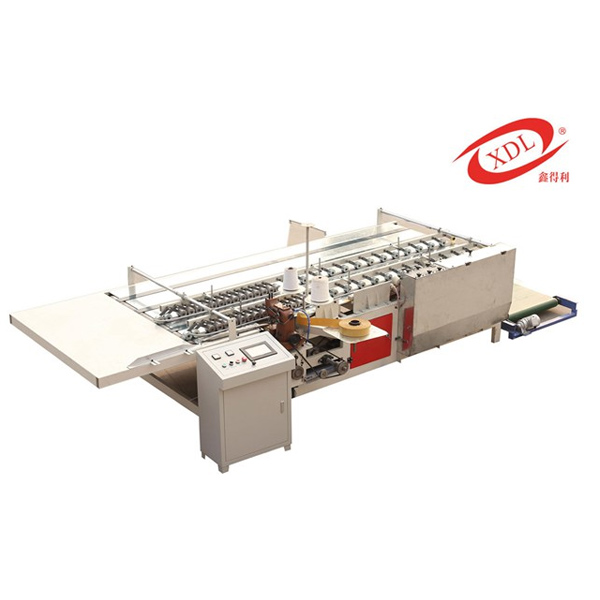
A manufacturer of integrated cutting, sewing, and printing machines for woven bags tells you: When the thread ends are even, it's a clear sign of shearing, just like neatly cutting the thread with a sharp pair of scissors. When encountering this situation, you should first look for the cause in the equipment, and this situation is basically due to the top thread (the top thread refers to the stitching on the front of the fabric, fed by the needle).
Taking a lockstitch sewing machine as an example, when the needle drops and pierces the sewing material with the suture, it first passes through the presser foot, and then the needle plate rises to a certain distance from the lowest point to form a thread loop, which is intertwined with the thread lead component (rotary shuttle or shuttle). During this period, whether it is due to the bending of the needle, incorrect placement of the presser foot, needle plate, rotary hook, etc., or irregular shape and size of parts, neat thread breakage may occur. Usually, the suture always passes through the thread hole in the direction of the long groove of the needle and comes out in the direction of the arc groove. The long groove of the needle is also called the thread-accommodating groove. It reduces most of the friction of the suture during the sewing process and allows it to shuttle smoothly and orderly through the sewing material. The arc groove allows the suture to form a thread bubble with its curved potential, creating conditions for the smooth interweaving of bottom threads. If the needle passes through the thread-passing parts such as the presser foot and needle plate, it will cut the thread neatly from the arc groove direction close to these thread-passing parts. At this time, one side of the needle thread groove is the movable knife, presser foot, needle plate, etc., and the matching side is undoubtedly the fixed knife. At this time, you should first check whether the needle used is bent (if it is bent, replace it immediately), then manually drive the needle bar to slowly drop, check the relative clearance between the needle and the presser foot, needle plate and other parts one by one, or adjust, grind or replace it.
When the thread guide (rotary hook, swing hook, looper, hook, etc.) is too close to the needle, and the thread is cut through the needle hole when hooking, the thread will break cleanly. Although the probability of this is very small, it should be taken seriously.
For overlock and covert sewing machines, the needle drop will increase, so parts such as needle guards and thread guards need to be carefully inspected.
In summary, the cause of a straight-end break should generally be sought in the equipment (excluding the possibility that the rotary hook cuts the thread to avoid accumulation when the thread used is obviously uneven in thickness and has a gourd-like shape).
2. The broken thread ends are short and fuzzy.
The second phenomenon, where the thread ends are short and fuzzy, is more common during the sewing process. Since the main forces acting on a sewing thread are, in order of magnitude, tension, friction, and torsion, it's necessary to explain some basic knowledge about sewing threads when studying this issue.
Sutures can generally be categorized into five basic elements: texture, diameter, direction of rotation, twist, and number of strands.
Texture: Divided into two main categories: natural fibers and synthetic fibers (mainly chemical fibers).
Common diameter: Based on worsted yarn, whether the thread is single-stranded or multi-stranded, we can assume that its cross-section is a circle and use it as a parameter to approximate the diameter.
Twist direction: This parameter was introduced to increase the strength and regularity of the sewing process. There are left-handed and right-handed twists. A simple way to distinguish them is to hold the thread still with one hand and twist the hanging part with the other hand. The direction in which the twist is tightened is the twist direction of the thread (left-handed threads are more commonly used).
Twist: Sewing thread is mostly made of two or more strands of fiber thread twisted together in one direction. The greater the twist, the stronger the thread, but the less stable the sewing process becomes, and the more likely there will be skipped stitches or loose threads during the sewing process.
Number of strands: The number of bundles that make up the thread. For example, 40S2 and 60S2 represent two different specifications of thread: 40-count yarn with 2 strands and 60-count yarn with 3 strands, respectively.
If thread breaks and appears as short, fuzzy ends during sewing, the issue to be addressed is thread strength, which falls under the operator's responsibility. The operator should carefully check whether the bottom thread is threaded correctly, whether there are any omissions, repeated wrappings, or unexpected increases in external force on the conveyor belt due to incorrect threading, or dead angles in the thread conveyor (this is an operational issue). If the above checks are all correct, and thread breakage cannot be avoided even after appropriately reducing the tension of the bottom and top threads (the lower limit of the bottom thread tension should be based on the absence of loose threads on both sides of the fabric), then the thread's inherent strength should be considered. For example, its texture, diameter, and whether it has become moldy to varying degrees should be considered, as well as whether it is suitable for the machine's rotation speed and meets the manufacturing process requirements of the fabric being sewn.
Sewing equipment can be categorized by its rotation speed, roughly into several speed zones: low-speed, medium-speed, high-speed, and ultra-high-speed. A thread designed for high-speed zones might work well when moved to a low-speed zone, but a thread designed for low-speed zones might not work well when moved to a high-speed zone. In layman's terms, "a stomach that's used to refined grains can't digest coarse food," and the same applies to machines.
While lower-quality thread is cheaper, and computer-controlled equipment can be adjusted to run at lower speeds, and machinery can reduce its speed by using smaller motors and pulleys, this misguided approach masks a significant reduction in production efficiency, ultimately proving counterproductive. The better way to calculate value accumulation is not by cutting costs, but by increasing revenue. Restraining machines from operating at their full capacity is unwise. Speed-up sewing methods should only be used when making sample garments or temporarily accepting small-batch production.
3. The broken thread ends are in the shape of long, fuzzy heads.
Another type of thread breakage is when the thread ends appear as long, fuzzy ends. This is essentially due to the thread twist being disrupted during the sewing process. The thread, originally twisted together, breaks off several strands before the last one breaks. While a small number of these breaks are caused by incorrect thread twist direction, the main cause is an unexpectedly high level of frictional resistance resulting from various factors.
Most sewing equipment upper threads (the bottom thread of any sewing equipment does not have left or right threads) use left-handed threads. Only a few models, such as the left straight needle of the lock-type double-needle machine and the arch sewing machine (imitation hand sewing machine), must use right-hand thread for upper thread before they can be used. This is because these devices destroy the twist of the left-hand thread during operation. For example, the left hook of the double-needle machine at this time can easily penetrate between the suture strands with damaged twist, causing the third form of thread breakage. If there is no right-hand thread to replace, the solution is to adjust the left hook to be as close to the needle as possible without touching the straight needle when the hook tip hooks the thread, and the thread hooking phase is delayed as much as possible without causing a jumper failure. The purpose of this is to make the thread bubble formed by the needle smaller and the twist less likely to be destroyed. At this time, the hook tip can hook all the strands of thread more accurately without causing thread breakage.
If the breakage is not caused by choosing the wrong rotation direction, the reason is simple: excessive local friction at the point where the wire passes through. However, troubleshooting this problem is quite complicated.
First, avoid using gourd-shaped thread (exaggeratedly speaking, this type of thread has severely uneven thickness, frequently alternating between excessive bulkiness and near-transparency, commonly known as "garbage thread"). Then, observe how the thread passes through the needle hole. Generally, the thread diameter should be approximately 80% of the smaller diameter of the elliptical needle hole. A thick needle and thin thread affect the stability of the thread bubble formation, causing skipped stitches during sewing, which is sometimes the cause of the second type of thread breakage. On the other hand, a thin needle and thick thread directly damage the thread twist at the thread hole, which is definitely a cause of the third type of thread breakage.
If the above two phenomena are ruled out, you need to calm down and carefully check each part of the thread one by one to see if the thread feels smooth enough when it receives the necessary friction. If it is not smooth enough, find out what is causing it.
Rust: Equipment that has not been used for a long time or has been poorly maintained is prone to rust, a phenomenon that is particularly severe in the relatively humid southern regions of my country. When the thread drags over a rusted thread guide instead of sliding over it, the smoothness of the fiber surface is damaged, causing the thread to break. The solution is to carefully remove the rust with sewing machine oil or replace the parts.
Burrs or grooves: When burrs or grooves form on the surface of the thread guide due to unintentional scratches or long-term use, they will damage the integrity of the thread fibers, causing thread breakage. A typical example is the gooseneck hook in the thread take-up section of a flatbed sewing machine. Over time, the thread will pull a groove into its thread guide hole. Thin threads can barely pass through, but slightly thicker threads are dragged and abraded, inevitably leading to breakage. The solution is to use a diamond file, fine sandpaper, sanding strips, or polishing thread coated with green oil to smooth the damaged surface. If this doesn't work, the part must be replaced.
Small gaps in thread feed in certain areas: Strictly speaking, sewing equipment in the sewing industry has a highly specialized division of labor, adapting to different work contents and dividing different work areas. Small gaps in certain areas are often caused by using equipment across different ranges. For example, blindly replacing equipment that processes ordinary sewing materials with thicker needles and thicker thread will inevitably reduce the gap between the needle and the presser foot, feed dog, needle plate hole, and other thread feed parts, causing poor feed and thread breakage. In this case, it is not recommended to try to maintain the working gap by regrinding, as this will damage the parts. It is recommended to replace the corresponding needle position (i.e., feed dog, needle plate, presser foot, etc.).
Properly address the interrelationship between fabric, needle, and thread.
This section discusses how to correctly understand the relationship between fabric, needle, and thread. The proper approach is to select the appropriate needle based on the characteristics of the fabric, and then choose the thread once the needle type and size are largely determined. However, some manufacturers using special processing techniques determine the thread based on the fabric before considering the appropriate needle.
The booming market in the garment industry demands a wide variety of fabrics, novel product styles, and exquisite processing techniques, which places higher demands on the coordination of the three elements mentioned above.
In terms of sewing materials, in addition to ordinary, easy-to-process medium-thick natural fibers, there are also a variety of sewing materials with different characteristics, such as thicker ones (down jackets, bedding, etc.), stiffer ones (tarpaulins, denim, etc.), lighter and smoother ones (nylon, silk, etc.), and more resilient ones (various leathers and imitation fur, etc.). In order to effectively avoid work failures caused by thick sewing materials not moving, fabric wrinkling, snags, skipped stitches, and broken threads, it is important to properly configure the sewing needles after implementing the processing equipment.
Generally speaking, when processing ordinary sewing fabric, ordinary sewing needles are sufficient. However, it is important to select a small-numbered needle (i.e., a small diameter of the working part) to ensure that the sewing fabric does not bend during operation (bending will cause needle breakage, skipped stitches, thread breakage, and other malfunctions). This is to ensure that the sewing fabric does not break or pull (the integrity of the fibers) and to reduce the frictional heat generated between the needle and the sewing fabric, thereby minimizing the occurrence of thread breakage.
For synthetic fiber fabrics, it is recommended to use SU-type super needles for synthetic fibers. These needles have a Teflon coating on the working surface, or PUS-type super needles for synthetic fibers with a ceramic composite gold plating on the working surface. The purpose of these special processes is to effectively avoid or minimize the frictional heat generated during the processing of synthetic fiber fabrics, thereby preventing a series of problems caused by needle heat, such as fiber melting, thread breakage, skipped stitches, and fabric breakage. If it is not immediately possible to replace the needles with special ones, silicone oil can be applied to the thread crossing area. The silicone oil can help cool the needles.
When processing thinner fabrics that are prone to fraying, it is recommended to use round-tipped needles with spherical tips.
When processing tough materials such as leather, special leather needles with diamond, triangular, or olive-shaped blades are selected to reduce frictional resistance during sewing, ensure the straightness of the needle during operation, and effectively avoid accidents such as needle breakage, skipped stitches, and thread breakage.
When processing thicker, stiffer fabrics such as tarpaulin and denim, consider using HS needles (high-speed needles). Compared to ordinary needles, HS needles have a larger eye and a tapered central section of the needle bar to reduce fabric friction. The needle surface is specially treated to prevent heat-melted fibers from adhering to the needle.
Here, I would like to strongly recommend the German-made Groz-Beckert titanium-plated machine needles to garment manufacturers. They have the following advantages:
First, its working surface is plated with titanium metal, which greatly enhances its rigidity and hardness, ensuring the straightness of the sewing process with needles of the same number. At the same time, titanium also has metallic properties that can reduce frictional heat.
Secondly, after titanium plating, important working parts of this needle, such as wire grooves, wire holes and arc grooves, have been strictly polished and smoothed. The light slipping of the wire passing parts not only greatly reduces the possibility of wire breakage, but also plays a very good role in solving floating wires in some special processes.
In summary, the use of this type of needle will effectively prevent problems such as needle breakage, skipped stitches, broken threads, and loose threads during the sewing process. Those who are interested may wish to give it a try.
Let's briefly talk about sewing thread. Good sewing thread is a reliable guarantee for sewing. The five key elements are just technical parameters. Only sewing thread with a certain degree of flexibility, uniform thickness, moderate twist, and smooth surface can be called ideal sewing thread.
One more thing to remind everyone is that sometimes the thread breaks not because the tension is too tight but because it is too loose. For example, when the thread is too loose, the equipment's lead-in components, such as the bend and the shuttle, repeatedly put the thread loop in, resulting in poor thread release and breakage.
In summary, there are countless reasons and phenomena related to thread breakage during sewing. The issues discussed here are merely common problems and their relatively simple solutions, without delving into specific quantitative analysis. This information is provided as a basic and general theoretical reference only.




 鲁公网安备 37162202000141号